Japanese road signs: meanings and common lookalikes
Content last verified against these sources
Recognize the sign, understand what it means, and decide what to do. These 14 schematic examples focus on signs that are easy to confuse when studying Japanese driving rules.
Read the whole sign
Check the main sign together with any supplementary plates. Plates may specify times, vehicle types, exceptions, or where a restriction starts, ends or continues. Read the wording and arrows for that sign assembly.
Stop and slow: both are inverted triangles
Read the characters as well as the shape. 止まれ means stop; 徐行 means slow. A slow sign does not replace a required stop.
Source Tokyo Metropolitan Police — stop and slow signs (English)
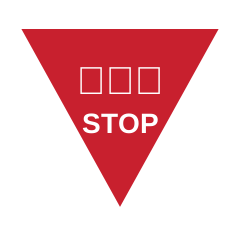
Stop
一時停止
You must come to a complete stop.
What to do: Stop before the stop line. If there is no line, stop immediately before the intersection and check safety.
Source Tokyo Metropolitan Police — stop and slow signs (English)
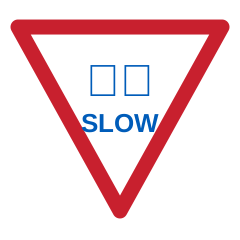
Slow
徐行
Proceed at a speed that lets you stop immediately.
What to do: Reduce speed enough to stop immediately. There is no universal 10 km/h value for this sign.
Source Tokyo Metropolitan Police — stop and slow signs (English) · e-Gov — Ordinance on Road Signs, Road Markings and Road Surface Markings (in Japanese)
Access restrictions: bar, slash or cross?
The white bar restricts entry from the direction you face. A red slash on a white field closes the road to vehicles. A red cross on a white field indicates a road closure. Do not confuse that white field with the blue field of the no-stopping-or-parking sign.
Source National Police Agency — traffic rules and road signs (English PDF) · Kanagawa Prefectural Police — road signs (English)
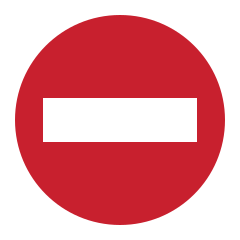
No entry
車両進入禁止
Vehicles must not enter from this direction.
What to do: Use another permitted route.
Source National Police Agency — traffic rules and road signs (English PDF)
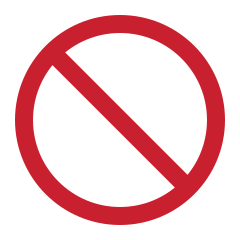
Closed to vehicles
車両通行止め
Vehicles, including bicycles, must not pass.
What to do: Choose a route that permits your vehicle.
Source Kanagawa Prefectural Police — road signs (English) · National Police Agency — traffic rules and road signs (English PDF)
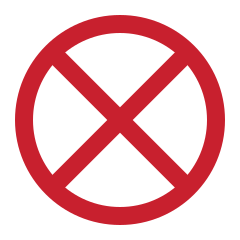
Road closed
通行止め
Passage is prohibited for pedestrians, vehicles and trams.
What to do: Choose another route.
Source Kanagawa Prefectural Police — road signs (English) · e-Gov — Ordinance on Road Signs, Road Markings and Road Surface Markings (in Japanese)
Directions: one way is different from straight only
A rectangular one-way sign tells you the permitted direction of travel along a road. A circular straight-only sign limits the direction you may proceed. Both examples below show an upward arrow; the surrounding shape matters.
Source Kanagawa Prefectural Police — road signs (English)

One way
一方通行
Traffic travels in the arrow’s direction.
What to do: Travel in the indicated direction; do not drive against it.
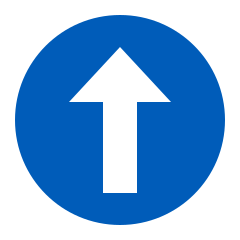
Straight only
指定方向外進行禁止
You may proceed only in the indicated direction.
What to do: Proceed straight where this restriction applies; do not turn left or right.
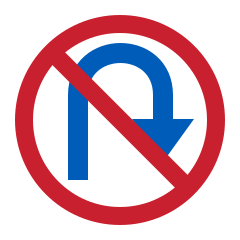
No U-turn
転回禁止
U-turns are prohibited.
What to do: Continue to a place where turning around is permitted.
Parking and stopping: one slash or a cross?
Both signs have a blue field and red border. One red slash means no parking; a red cross means no stopping or parking. A short stop is not automatically lawful just because you see the single-slash sign. Other rules and supplementary plates still apply.
Source Kanagawa Prefectural Police — road signs (English)
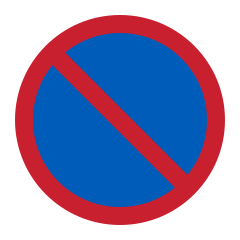
No parking
駐車禁止
Parking is prohibited.
What to do: Find a permitted parking place. Do not treat this sign as blanket permission for brief stops.
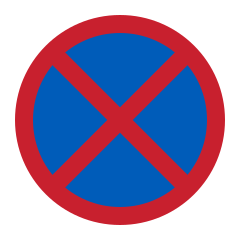
No stopping or parking
駐停車禁止
Both stopping and parking are prohibited.
What to do: Do not pull over to wait, park, load or unload here.
This does not tell you to ignore a red light or an unavoidable stop for safety.
Speed and height limits: read the number
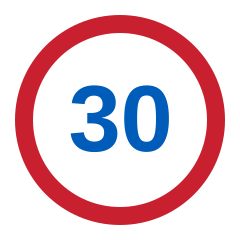
Maximum speed
最高速度
The example sets a maximum speed of 30 km/h.
What to do: Do not exceed the posted maximum. Drive slower when conditions require.
30 is the example shown here, not a universal speed limit for Japanese roads.
Source National Police Agency — traffic rules and road signs (English PDF)
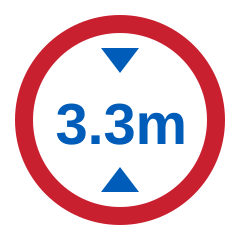
Height limit
高さ制限
Vehicles whose height, including their load, exceeds the displayed value must not pass.
What to do: Check your vehicle’s loaded height and use another route if it exceeds the limit.
The example shows 3.3 m; read the value on the actual sign.
Source Kanagawa Prefectural Police — road signs (English) · e-Gov — Ordinance on Road Signs, Road Markings and Road Surface Markings (in Japanese)
Warnings: prepare for the hazard ahead
These yellow diamonds warn about the road ahead. A crossroads warning does not grant priority or, by itself, require a stop. Prepare for the hazard and follow the signs, markings and traffic conditions at the location.
Source MLIT — road-sign chart (PDF) (in Japanese) · e-Gov — Ordinance on Road Signs, Road Markings and Road Surface Markings (in Japanese)
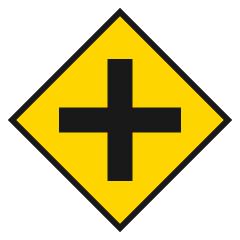
Crossroads ahead
+形道路交差点あり
A crossroads lies ahead.
What to do: Look for crossing traffic and be ready to respond safely.
Source MLIT — road-sign chart (PDF) (in Japanese)
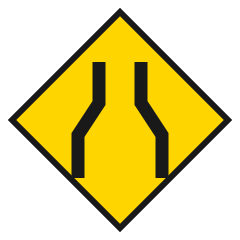
Road narrows
幅員減少
The road becomes narrower ahead.
What to do: Adjust your speed and position for the narrower road. Do not assume you have priority.
This is a width warning, not the lane-reduction sign.
Source MLIT — road-sign chart (PDF) (in Japanese)
Try the signs-and-markings drill
Use the pictures above as a lookup, then test yourself with the existing five-question drill. The reference adds no new quiz questions.
Sources
Sign meanings and forms were checked against these official references. The illustrations on this page are original schematic drawings, not reproductions supplied by these authorities.
- National Police Agency — traffic rules and road signs (English PDF)
https://www.npa.go.jp/english/bureau/traffic/document/r8_followtherules_en02.pdf - Kanagawa Prefectural Police — road signs (English)
https://www.police.pref.kanagawa.jp/about_kpp/english/engf1007.html - Tokyo Metropolitan Police — stop and slow signs (English)
https://www.keishicho.metro.tokyo.lg.jp/multilingual/english/traffic_safety/traffic_rules/hyosiki.html - MLIT — road-sign chart (PDF) (in Japanese)
https://www.mlit.go.jp/road/sign/sign/douro/ichiran.pdf - e-Gov — Ordinance on Road Signs, Road Markings and Road Surface Markings (in Japanese)
https://laws.e-gov.go.jp/law/335M50004002003