Intersections and Right of Way — 5 Practice Questions
Intersection questions are right-of-way questions. Where there is no signal and no sign, the vehicle coming from your left has priority. Where the two roads are obviously different widths, the wider road has priority. Where a priority-road sign is posted, the sign settles it.
Confusing that order of precedence tends to take the turning-procedure questions down with it. The regulars alongside it are the duty to wait for oncoming and left-turning traffic when you turn right, and the ban on overtaking inside an intersection or on the approach to one.
The five questions below cover them. Where a diagram is shown, fix the position of your vehicle relative to the other one before you answer.
The five questions
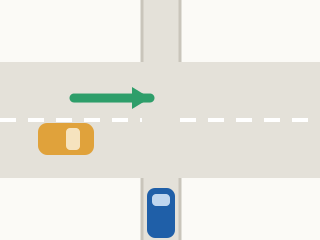
At an intersection with no signals or signs, a vehicle on the narrower road has priority over a vehicle on the wider intersecting road.
Show the answer and explanation
Answer False
Explanation False. It is the reverse: the vehicle on the narrower road must yield to the vehicle on the obviously wider road.
Basis in law 道路交通法 第36条 / Road Traffic Act Art. 36
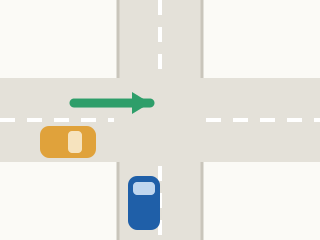
At an intersection of roads of equal width with no signals, the vehicle coming from your left has priority.
Show the answer and explanation
Answer True
Explanation Left-side priority (左方優先) applies when the roads are of similar width and there is no other priority rule.
Basis in law 道路交通法 第36条 / Road Traffic Act Art. 36
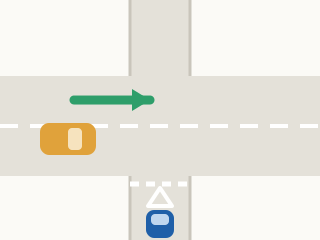
When the road crossing yours is a designated priority road (優先道路), you must yield to vehicles travelling on it.
Show the answer and explanation
Answer True
Explanation Traffic on a marked priority road has the right of way; you slow down and give way.
Basis in law 道路交通法 第36条第2項 / Road Traffic Act Art. 36(2)
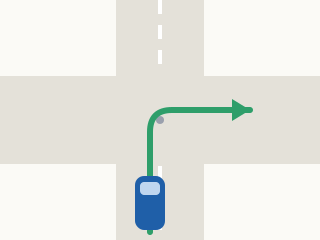
When turning right at an intersection, you should swing wide and turn from the left part of your lane.
Show the answer and explanation
Answer False
Explanation False. Move toward the centre in advance and turn tightly just inside the centre of the intersection — not by swinging wide from the left.
Basis in law 道路交通法 第34条 / Road Traffic Act Art. 34
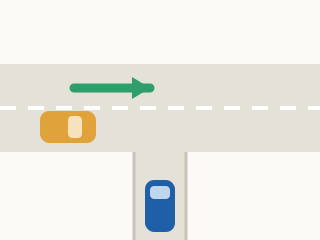
At a T-junction, a vehicle on the continuing (through) road has priority over one emerging from the road that ends there.
Show the answer and explanation
Answer True
Explanation Traffic on the through road generally has priority over traffic from the terminating road.
Basis in law 道路交通法 第36条・第37条