Pedestrian Crossings — 5 Practice Questions
Content updated
These questions cover the rules that protect people on foot. The core duties are stopping at an unsignalised crossing when somebody is crossing or clearly about to, the ban on overtaking or passing within 30 metres before a crossing, and slowing to a safe speed and leaving a safe gap when you pass near pedestrians.
The assumptions that cost marks are predictable: that slowing down is enough if nobody is on the crossing yet, that the duty to stop only starts once a pedestrian has stepped out, and that pedestrians have no priority away from a marked crossing. None of the three survives contact with the actual wording of the law.
The five questions below test each of them.
The five questions
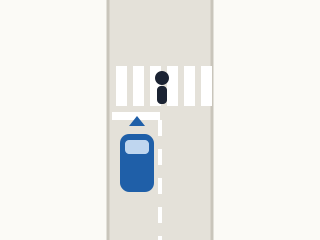
When a pedestrian is crossing, or is clearly about to cross, at a pedestrian crossing that has no traffic signal, you must stop and let them cross.
Show the answer and explanation
Answer True
Explanation Pedestrians have absolute priority at crossings. If anyone is on the crossing or about to step onto it, the vehicle must stop — not yielding here is both a top exam mistake and a heavily enforced violation.
Basis in law 道路交通法 第38条 / Road Traffic Act Art. 38
If a pedestrian is waiting at the curb to cross but has not yet stepped onto a signal-less crossing, the vehicle always has priority and may continue through.
Show the answer and explanation
Answer False
Explanation False. A pedestrian waiting to cross counts as 'about to cross' (渡ろうとしている), so you must still stop. The vehicle does not have priority just because the pedestrian hasn't stepped off the curb yet.
Basis in law 道路交通法 第38条第1項 / Road Traffic Act Art. 38(1)
When you see a small child walking alone, or an elderly or disabled person who appears unsteady, near your path, you must slow down or stop so as not to endanger them.
Show the answer and explanation
Answer True
Explanation Drivers owe a specific duty of extra care to vulnerable people on or near the road and must slow or stop to keep them safe.
Basis in law 道路交通法 第71条第2号 / Road Traffic Act Art. 71
If a vehicle ahead is stopped at a crossing to let pedestrians pass, you must not overtake it without first stopping to make sure no one is crossing.
Show the answer and explanation
Answer True
Explanation A stopped car may hide a crossing pedestrian; you must stop before passing it to be sure.
Basis in law 道路交通法 第38条第3項 / Road Traffic Act Art. 38(3)
Splashing a pedestrian with muddy water by driving through a puddle is not something the driver can be blamed for.
Show the answer and explanation
Answer False
Explanation False. Drivers must slow or take care to avoid splashing pedestrians; doing so can be penalised.
Basis in law 道路交通法 第71条第1号 / 各都道府県規則