Traffic Signals — 5 Practice Questions
Signal questions concentrate on three things: what a yellow light actually requires of you, how flashing signals differ from steady ones, and what an arrow signal permits.
Candidates lose several marks here by treating yellow as "proceed with caution". The rule is that you stop — unless you are already too close to stop safely at the stop line. Flashing signals then split by colour: flashing red means come to a complete stop, flashing yellow means proceed with care for other traffic.
The five questions below check all of it. Where a diagram is shown, read the diagram before you decide.
The five questions

A yellow (amber) light means that, as a rule, vehicles must stop at the stop line; you may proceed only if you are already so close that stopping safely is impossible.
Show the answer and explanation
Answer True
Explanation Yellow is a stop signal in principle. It does not mean 'speed up' or 'proceed with care' — you continue only when stopping would itself be dangerous.
Basis in law 道路交通法施行令 第2条 / Enforcement Order Art. 2
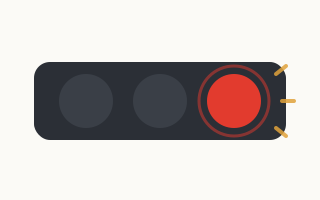
A flashing red signal means you may slow down and proceed with caution without stopping.
Show the answer and explanation
Answer False
Explanation False. A flashing RED requires a complete stop and a safety check, just like a stop sign. It is the flashing YELLOW that means 'proceed with caution'.
Basis in law 道路交通法施行令 第2条 / Enforcement Order Art. 2

At a green light, a vehicle may go straight ahead, turn left, or turn right (while still yielding as required).
Show the answer and explanation
Answer True
Explanation Green permits proceeding straight, left, or right. A right turn must still not obstruct oncoming straight/left traffic.
Basis in law 道路交通法施行令 第2条 / Enforcement Order Art. 2

At a red light you may turn left after stopping, even with no arrow signal, as is allowed in some other countries.
Show the answer and explanation
Answer False
Explanation False. Japan has no general 'left turn on red'. You may only proceed on red where a blue arrow or a 左折可 sign permits it.
Basis in law 道路交通法施行令 第2条

When a blue (green) arrow signal is lit, vehicles may proceed in the direction of the arrow even though the main light is red.
Show the answer and explanation
Answer True
Explanation An arrow signal grants movement in its direction regardless of the red round light.
Basis in law 道路交通法施行令 第2条